Shops in Dushanbe sell through Instagram direct messages: no site, no stock system, no way for a customer to see what is actually on the shelf. CLOTH.TJ gives the shop one link. The customer taps it inside Instagram, sees live stock and sizes, and orders — without a single message to the owner.
"Do you have a 46?", "How much?", "Is this still available?" — the owner answers by hand, all day, and most of it never becomes a sale.
An item sold in the shop is still in the feed. A customer orders something that no longer exists and leaves disappointed.
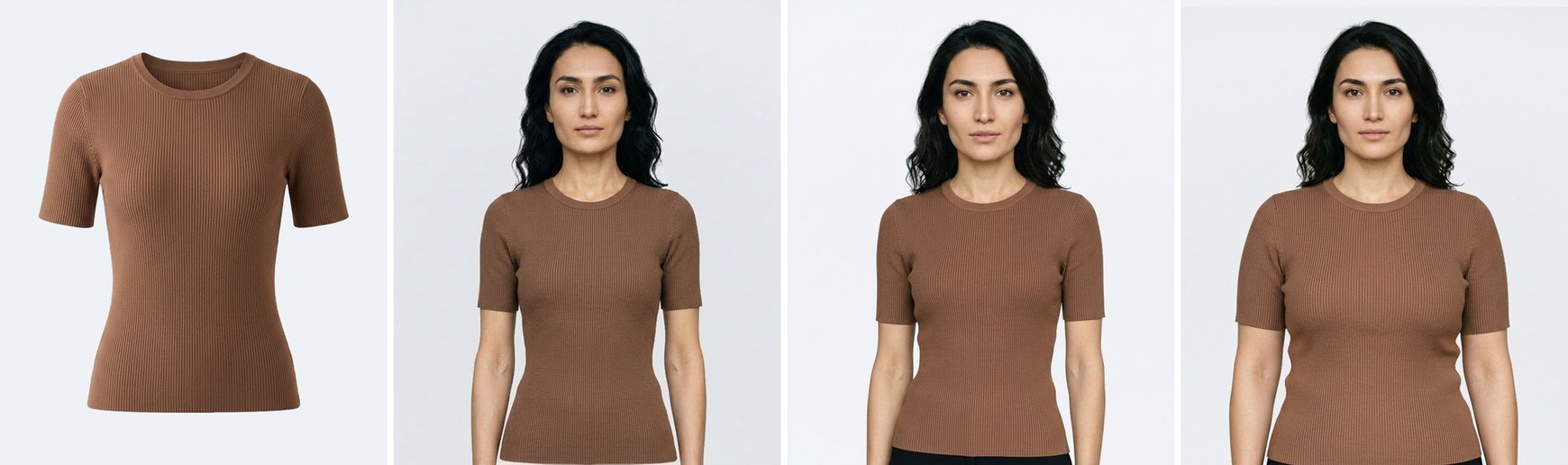
A proper shoot costs money and time, so most items are photographed once, on one model, on one body — and half the audience cannot tell how it would fit.
The shop pins one link in its Instagram bio. It opens inside Instagram, in Telegram and in any browser — nothing to install. Catalogue, prices, sizes and real availability, in Russian and Tajik.
Quantities per size. Selling an item in the shop removes that size from the storefront immediately; an online order removes it from the shelf. One number, not two.
Orders arrive assembled — items, sizes, name, phone, address, payment method and the transfer receipt. Money goes straight to the shop's own card: we take no commission.
The owner uploads the photo they were going to post anyway. The same item is then shown on a slim, a regular and a fuller figure. The customer picks their own build once, and the whole catalogue is shown on it. No shoot, no model, no studio.
Every generated frame carries a caption saying it is not a real photograph, and the real product shot sits next to it. Shops with their own photography switch generation off and the storefront runs on their images — everything else works the same.
A clothing shop in Dushanbe with a hundred items has two options today. It can commission a website — the open price from local studios is 7 900 somoni to build and about 1 250 a month to keep it alive and promoted — or it can keep selling in Instagram direct messages. Inventory software is a separate purchase again: the official 1C price list for Tajikistan puts basic stock accounting at 4 136 somoni. For a shop whose monthly turnover is measured in a few thousand somoni, that arithmetic ends the conversation.
So the shop stays in chat, and three things follow from that, none of them obvious from outside.
Twenty conversations a day, four minutes each, is forty hours a month — five working days spent typing the same three answers. Those are days not spent buying stock, counting it or selling in the room.
One photo, one model, one body. A buyer at size 50 has no way to judge a garment shot on a size 42, and returns are expensive for a shop that ships by courier and takes cash on delivery.
An item sold in the room is still in the feed. The customer who orders it waits, then hears no. That is not a lost sale — it is a lost customer, and in a city this size they tell people.
CLOTH puts the storefront, the stock ledger and the counter into one phone for 490 somoni a month — roughly $53 — with nothing to install, no commission on sales and no per-item fee. Money goes straight to the shop's own card; we never touch it. The barrier that used to be a five-figure decision becomes a monthly one the shop can stop at any time.
Two parts of that matter more than the price.
Photography stops being the gate. The shop uploads the picture it was going to post anyway, and the same garment is shown on three builds, captioned by size range — 42–44, 46–48, 50–54. No studio, no model, no shoot day. Every generated frame says on the card that it is not a photograph, and the real product shot sits next to it. Shops with their own photography switch generation off entirely and lose nothing else.
The storefront speaks Tajik. Every screen a buyer sees exists in Russian and in Tajik, and the shop does not have to maintain two catalogues to get it. Most commerce tools available here are Russian-only, which quietly decides who the customer is.
There is also a direction of travel the shops feel before they can name it. Tajikistan has required real-time cash registers since Government Decree No. 432 of 9 October 2021, and small retail is being pushed to keep records it has never kept. Our till is not a fiscal one and we say so plainly — a shop that needs a registered cash register still needs one. But the habit of counting stock, and the data that comes with it, is what makes that step possible instead of terrifying.
Prices quoted here are the public rates of webart.tj and somona.net and the official 1C price list for Tajikistan, converted at the National Bank of Tajikistan rate of 9.2525 somoni to the dollar. All of it is checkable in a minute, which is the point.
Colibrifitt, a sportswear shop in Dushanbe, has been running its storefront since August 2026 — the owner adds items herself, from a phone. The other six storefronts are private demos built from shops' own public Instagram photos before the first conversation: the shop opens a link and sees its own goods, priced and in stock. Those demos are excluded from search engines and the link exists only for that shop — until its owner says yes, it is a proposal, not a site.
The company is a registered sole proprietorship in Dushanbe since 31 October 2025. The product has been in production since October 2025.
We are deliberately not quoting a market size. We are counting it bottom-up, shop by shop, and would rather show you the count than a slide.
Digitising one garment costs about 27 US cents: three try-on frames and a product shot on Google Vertex AI, measured on our own billing, not estimated. Footwear costs about 20 cents — we stopped rendering three body types for shoes, where the body is not visible anyway, and render one foot from two angles instead. A shop of 300 garments costs roughly $81 to onboard against a subscription of 490 somoni a month, about $53 at the National Bank rate. The subscription pays the onboarding back inside the first two months.
What limits growth is not cost. It is the human check of generated frames before a storefront goes live. The frame plan went from nine images per product to four, and to three for footwear — that is the line we keep optimising.
Infrastructure runs on Railway; image generation on Google Cloud Vertex AI; the stack is FastAPI, SQLModel and React.

I build CLOTH myself and answer for it myself — to shop owners, on calls and in chat.
Before this I ran a national digital-literacy project for OSCE and American Spaces, and led the course department of a skills accelerator. I also spent time inside a clothing boutique fixing its till, returns and stock — which is why this product is about inventory and people, not about pictures.
We are bootstrapped and pre-seed. Useful to us, in this order: cloud credits that keep generation running; introductions to clothing retail in Central Asia; and investors who are comfortable with a market that has to be built shop by shop.
Or open a live storefront and try it: cloth.tj/s/demo